
Peptide Education Center
Everything you need to understand the therapies available through Velacore's physician network — what they are, how they work, and what to expect. All content is educational only and does not constitute medical advice.
What Are Peptides?
Peptides are short chains of amino acids — the same building blocks your body uses to create proteins. In simple terms, peptides act like messengers in the body. They help send signals to specific cells and systems that may influence metabolism, recovery, energy, sleep, skin health, hormone signaling, and overall wellness.
How Peptides Work
Peptides connect with specific receptors in the body, almost like a key fitting into a lock. Once that signal is received, the body may respond by supporting a targeted function — such as recovery, appetite regulation, tissue support, cellular repair, or energy balance.
Peptides do not replace healthy habits, nutrition, exercise, sleep, or medical care. When appropriate, they may be used as part of a structured wellness protocol.
Why People Explore Peptide Therapy
Peptide protocols may be considered for people looking to support:
- Weight management and metabolic health
- Recovery from exercise, strain, or overuse
- Energy, focus, and mental clarity
- Sleep quality and recovery
- Healthy aging and longevity
- Skin, hair, and tissue health
- Overall performance and vitality
A Provider-Guided Approach
At Velacore Health, peptide therapy starts with a structured intake and provider review. Your goals, health history, medications, lifestyle, and wellness profile are reviewed before any protocol is considered.
When appropriate, protocols are reviewed by licensed, independent partner physicians and fulfilled through state-licensed 503A compounding pharmacy partners, with care team support throughout the process.
Built Around Your Goals
Peptides are not magic, and they are not shortcuts. They work best when paired with the right foundation: nutrition, hydration, movement, sleep, consistency, and proper medical oversight.
Velacore Health helps you take a more personalized, structured approach to looking, feeling, recovering, and performing at your best.
How GLP-1s & Peptides Work Together
GLP-1 medications and peptides can complement each other because they target different aspects of metabolic health.
GLP-1s Create Control
They primarily support appetite regulation and blood-sugar signaling — helping clients establish structure around eating, reduce cravings, and build consistency.
Peptides Build Capacity
They enhance cellular energy, recovery, sleep quality, body composition, and metabolic efficiency — supporting the body internally so habits can stick.
In practical terms:
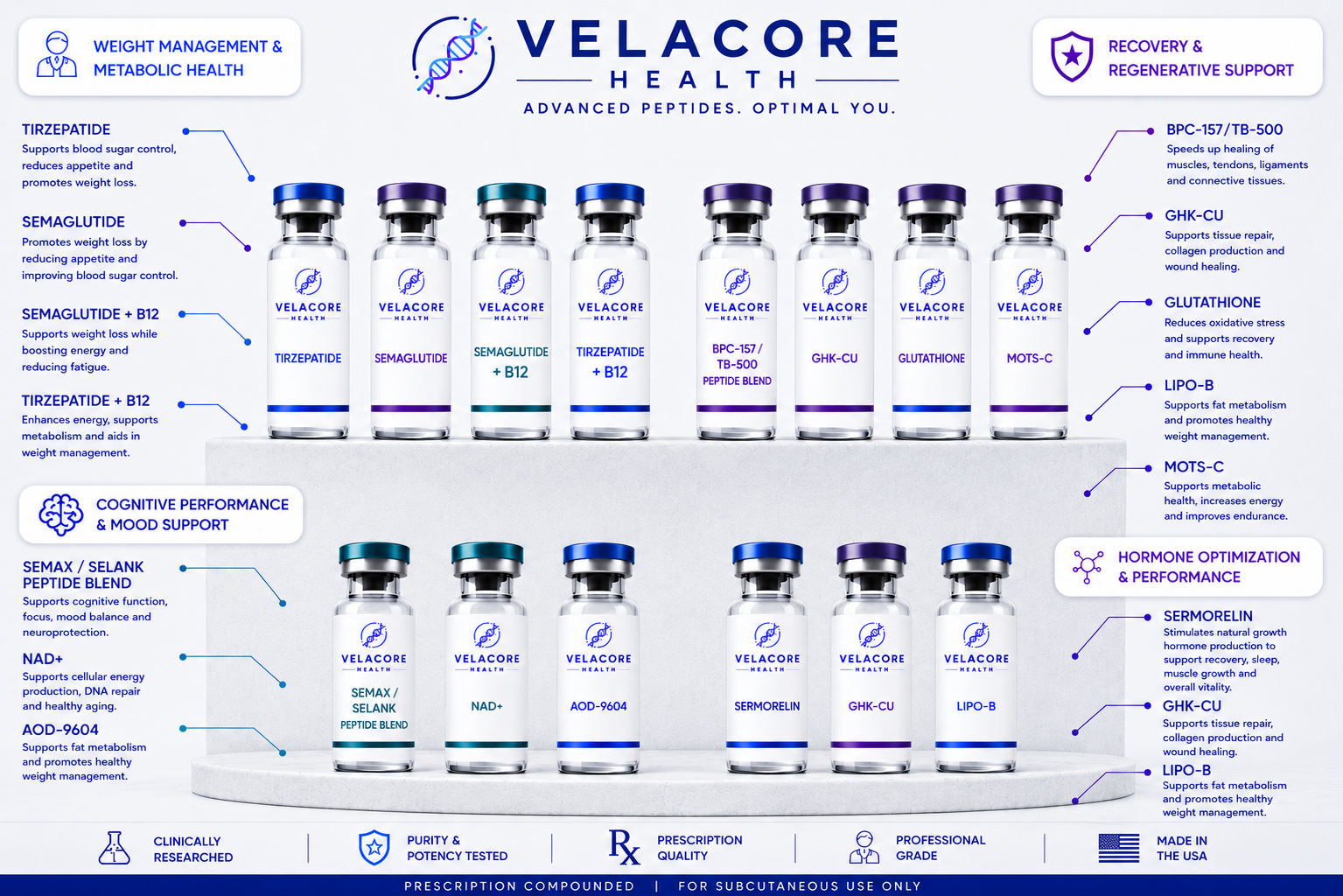
Metabolic & Weight Management Support: Semaglutide & Tirzepatide

Semaglutide
Semaglutide is a GLP-1 medication that supports appetite regulation and metabolic signaling. It works by helping the body send clearer messages about fullness and blood-sugar balance, which may make structured eating easier over time.
Is This Right for Me? →What it may support:
- Reduced cravings and "food noise"
- Feeling full on appropriate portions
- More stable blood-sugar levels
- Structure around meal timing
- Weight management when paired with lifestyle habits
Who it may be for:
- Those wanting medically guided weight support
- Individuals struggling with appetite control
- People who haven't progressed with lifestyle changes alone
- Those seeking a budget-accessible GLP-1 option

Tirzepatide
Tirzepatide activates both GLP-1 and GIP pathways, which may offer broader support for appetite control, metabolic regulation, and energy balance.
Is This Right for Me? →What it may support:
- Stronger appetite control and reduced food noise
- More efficient metabolism and energy use
- Support during weight-loss plateaus
- Blood-sugar and insulin response balance
Who it may be for:
- Individuals needing advanced appetite and fullness support
- Those with long-term difficulty controlling cravings
- Clients in structured weight-management programs

A growth-hormone fragment studied for fat-metabolism support. Used as an adjunct during fat-loss phases — not a standalone weight-loss medication.
Is This Right for Me? →
A metabolic support injection combining lipotropic compounds with B vitamins to support fat metabolism, energy production, and liver function.
Is This Right for Me? →Performance, Energy & Cognitive: NAD+ & Semax/Selank

NAD+
NAD+ is a molecule your body uses in every cell to help convert food into usable energy. Levels naturally decline with age and chronic stress.
Is This Right for Me? →What it may support:
- Daytime energy and overall resilience
- Mental clarity, focus, and productivity
- Recovery from stress, travel, or intense training
- Cellular repair and long-term metabolic health
Who it may be for:
- Individuals seeking energy and focus support
- Busy professionals and high-performers
- Those in high-stress or high-travel seasons

Semax / Selank Blend
A peptide combination used to support focus, mood balance, and overall stress resilience. Designed to provide calm, focused energy — not stimulant-driven alertness.
Is This Right for Me? →What it may support:
- Calm, focused energy (not wired or jittery)
- Improved ability to manage daily stress
- Increased productivity and mental clarity
Who it may be for:
- Individuals wanting focus without stimulants
- Those experiencing stress or mental fatigue
Recovery & Tissue Support — The Wolverine Blend”

BPC-157 / TB-500
A peptide combination commonly used by active individuals who want supportive options for recovery, soft-tissue balance, and training consistency.
Is This Right for Me? →What it may support:
- Everyday joint and tendon comfort
- Recovery after training, strain, or overuse
- Support during physical therapy or rehab plans
- Training consistency and movement maintenance
Who it may be for:
- Active individuals needing recovery support
- Clients returning to training or rehab
- Those with chronic joint or tendon discomfort
Longevity & Healthy Aging: Sermorelin, MOTS-C, GHK-Cu

Sermorelin
A peptide that signals the pituitary gland to support the body's own natural growth-hormone production.
Is This Right for Me? →What it may support:
- Deeper, more restorative sleep
- Recovery from workouts and daily stress
- Lean body mass and body composition goals
- Mood, motivation, and overall vitality
Who it may be for:
- Individuals needing better recovery or sleep quality
- Clients focused on body composition
- Those pursuing long-term regeneration goals

MOTS-C
Supports cellular energy and helps the body use fuel more efficiently.
Is This Right for Me? →What it may support:
- Healthy aging and physical resilience
- Exercise tolerance and daily stamina
- Metabolic flexibility and "bounce back" energy

GHK-Cu
A copper-binding peptide used to support skin appearance, vibrancy, hydration, and overall skin quality.
Is This Right for Me? →What it may support:
- Skin quality, texture, and overall glow
- Hair and tissue health
- Cellular repair and collagen support
Cellular Support: Glutathione

Glutathione
Glutathione is a powerful antioxidant your body produces naturally to help neutralize oxidative stress. It plays an important role in keeping cells healthy and supporting the body's repair processes.
Is This Right for Me? →What it may support:
- Cellular repair and recovery
- Detoxification and antioxidant support
- Immune system function
- Skin health and overall vitality
Who it may be for:
- Those wanting detox and cellular repair support
- Individuals who get sick easily or recover slowly
- Frequent travelers or those with high toxin exposure
Microdosing — A Gentler Approach to Weight Management Support
A gentler approach to GLP-1 support
Microdosing involves using GLP-1 medications (semaglutide or tirzepatide) at lower-than-standard doses to support appetite and metabolic control with better tolerability. It is considered off-label, which is common in medicine. Only prescribing clinicians determine eligibility.
What microdosing may support:
- Gentle appetite and craving control
- Keeping weight off after a weight-loss program
- Blood sugar and insulin balance
- Perimenopause or menopause-related weight changes
- Steadier daytime energy during high-stress seasons
Who it may be for:
- Adults near a healthy weight who fight cravings or slow weight regain
- Those who completed a full-dose program and want maintenance
- Individuals preferring a gentler approach
Side Effects: What to Expect vs. Red Flags
Expected / Adjustment Symptoms
Common during early phases — typically resolve over time:
Appetite & Eating Changes:
- Reduced appetite
- Feeling full faster
- Decreased snacking or cravings
Early Adjustment Symptoms:
- Mild fatigue
- Slight lightheadedness when under-eating
Mild Digestive Changes:
- Mild nausea or bloating
- Occasional mild constipation
Red Flag Symptoms — Contact Care Team Immediately
Severe or Escalating GI Symptoms:
- Severe abdominal pain
- Repeated vomiting
- Inability to keep fluids down
Hydration or Metabolic Symptoms:
- Signs of dehydration (dark urine, dizziness, dry mouth)
- Extreme weakness or feeling faint
Safety-Critical Symptoms:
- Chest pain or severe shortness of breath
- Sudden, intense stomach cramping
Emergency Callout
For chest pain, difficulty breathing, or severe reactions — call 911 or go to the nearest emergency room immediately. Then notify the care team.
For all other symptoms: Contact the Velacore care team via the patient care text line. Do not contact coaching staff for medical questions.
The Medical Process: How It Works
Wellness Evaluation
Assess your goals, lifestyle, and baseline health markers. Determines the right program path before any medical review.
Choose Your Program
Select a wellness program. This is a request — a licensed physician will determine if any medication is appropriate for you.
Complete Medical Intake
Secure online form covering medical history, diagnoses, medications, supplements, allergies, lifestyle, and goals.
Physician Review Fees
$35 for single-vial / $50 for multi-vial, plus $35 shipping. Collected by the independent medical group. Refunded in full if not approved.
Physician Review
Independent licensed physician reviews your intake and decides: approve, request more info, or decline.
Pharmacy Fulfillment
If approved, 503A pharmacy prepares your patient-specific formulation and ships it directly to you.
Care Team Support
Direct text access to the care team throughout your protocol. Medical questions routed to the appropriate team.
Monitoring & Adjustments
Follow-up labs included in long-term programs. Dosing adjustments are physician-only.
What Are Peptides? (In Plain Terms)
You've probably heard the word peptide a lot lately — in wellness circles, from doctors, and across social media. But what actually is a peptide?
Here's the simplest way to think about it:
Peptides are the messengers.
Your body is constantly sending messages. From your brain to your muscles. From your gut to your hormones. From your cells to your immune system. These messages tell your body what to do and when to do it.
They're small proteins — short chains of amino acids, the same building blocks your body already uses — that carry specific signals to specific parts of your body. Think of them like text messages your cells send to each other. Short. Direct. Targeted.
Does My Body Already Make Peptides?
Yes — all the time. Insulin is a peptide. Oxytocin (the bonding hormone) is a peptide. Growth hormone releasing hormone is a peptide.
Your body has been using peptides your entire life. You just may not have known what to call them.
The difference with peptide therapy is that specific peptides — ones that naturally decline with age, stress, injury, or illness — can be reintroduced in a controlled, physician-guided way to support specific goals.
What Can Peptides Support?
Different peptides have different jobs. Some signal the body to support fat metabolism. Others help with tissue repair. Some support sleep and recovery. Others influence appetite, energy production, or cellular health.
It's not one-size-fits-all. The right peptide — or combination of peptides — depends entirely on your health history, your goals, and what an independent physician determines is appropriate for you.
Are Peptides Safe?
Peptides are generally considered well-tolerated because they work with the body's existing systems rather than forcing a response. They're not stimulants. They don't override your biology. They send signals your body already understands — they just reinforce or re-introduce them.
That said, no therapy is without risk, and peptide therapy is not appropriate for everyone. That's exactly why Velacore requires a physician review before any protocol begins.
How Are They Different From Steroids or HGH?
This is one of the most common questions — and a fair one.
Steroids / HGH
Steroids directly introduce synthetic hormones into your body, often at levels far above what your body would naturally produce. They work fast, but they override your body's own systems and can cause significant side effects.
HGH directly introduces the hormone itself into the bloodstream, bypassing your body's natural regulation.
Most Peptides
Most peptides work differently. Instead of replacing or overriding, they signal.
A peptide like sermorelin, for example, signals your pituitary gland to produce more of its own growth hormone — naturally, within the range your body is designed for.
The result is a more gradual, more sustainable, and generally better-tolerated process.
What Peptides Are Not
Peptides are not a shortcut. They are not a replacement for nutrition, sleep, movement, or consistency. They are not magic.
What they can be — when used correctly, under proper medical guidance — is a meaningful addition to a structured wellness approach.
A tool that supports your foundation, not a substitute for building one.
GETTING STARTED
-
Velacore Health is a wellness platform that combines structured wellness resources with coordinated access to independent physician-directed peptide and GLP-1 programs. We provide the tools, support, and coordination — an independent licensed physician makes all medical decisions.
-
That's determined by an independent licensed physician after reviewing your full health intake — not by us. When you join a Velacore program, eligible members complete a structured intake form that is reviewed by an independent physician. They evaluate your health history, current medications, goals, and lifestyle before making any determination. We cannot tell you in advance whether you'll be approved — that decision belongs entirely to the physician.
-
No. You start by completing a Velacore program intake. If you're eligible for the physician referral pathway, your intake is reviewed directly by an independent licensed physician — no prior referral needed.
PEPTIDE THERAPY — COMMON QUESTIONS
-
No — not necessarily, and this is one of the most important things to understand upfront. Most peptide protocols are structured with a goal and a timeline in mind. Some people use peptides for a defined period — say, 3 to 6 months — to support a specific outcome like recovery, weight management, or sleep improvement, then cycle off. Others may use them longer-term under ongoing physician supervision. It depends entirely on the peptide, your goal, and your physician's guidance. A good protocol has an end point — or at minimum, regular reassessment. Velacore's physician network follows structured protocols, not open-ended prescriptions. Your physician determines duration and any continuation.
-
Peptide overdose in the traditional sense is not common — peptides are not opioids or stimulants with a narrow margin of safety. However, taking more than the prescribed dose can cause side effects, discomfort, and potentially disrupt the very systems you're trying to support. More is not better. Peptide protocols are dosed precisely for a reason. Your prescribing physician sets the dose based on your individual profile. Deviating from that — in either direction — without medical guidance is not recommended. Always follow your prescribed protocol and contact the care team with any concerns before making changes.
-
No long-term illness has been definitively linked to properly dosed, physician-supervised peptide therapy in the research available today. The peptides used in structured wellness protocols have generally been studied and used clinically for years without evidence of serious long-term harm at therapeutic doses. That said, the long-term data on some newer peptides is still developing — and this is exactly why physician oversight matters. A licensed physician reviews your full health history before prescribing, monitors your progress, and adjusts or discontinues your protocol if any concerns arise. Peptide therapy is not appropriate for everyone. People with certain medical conditions, hormone-sensitive cancers, or active illnesses may not be candidates. This is assessed individually during the physician review.
-
Standard workplace or legal drug tests do not screen for peptides — they're looking for substances like THC, opioids, amphetamines, cocaine, and similar drugs. Peptides are not on these panels. However, if you are a competitive athlete subject to anti-doping testing (WADA, USADA, or similar organizations), some peptides are on prohibited lists. If you compete professionally or at any tested level, disclose all medications and supplements to your physician and check the relevant prohibited substance list before starting any protocol.
-
It depends on the goal and the peptide. Some outcomes — like tissue repair supported by BPC-157 — can be lasting once healing has occurred. Others, like appetite regulation from GLP-1s, may require ongoing support to maintain results. This is why pairing peptide therapy with real lifestyle habits matters. The goal of any Velacore program is to use targeted support to build a foundation — not to create dependency. Your physician will discuss realistic expectations based on your protocol.
-
Possibly — but this is determined solely by your prescribing physician after reviewing your current medication list during your intake. Do not start any peptide protocol without disclosing all current medications, supplements, and health conditions. Drug interactions are real and your physician needs the full picture to make a safe determination.
-
Do not double-dose to make up for a missed one. Most peptide protocols are designed to be consistent rather than compensatory. If you miss a dose, continue with your next scheduled dose as normal and contact the care team if you have questions about your specific protocol.
THE PROCESS & FEES
-
The compounded medications available through our physician network are prepared by state-licensed 503A pharmacies. Because they are patient-specific formulations, they are not labeled FDA-approved — as is true of all compounded medications in the U.S. by law. This is a regulatory distinction, not a safety concern. Safety is ensured through independent physician oversight, licensed pharmacy standards, and ongoing monitoring.
-
Semaglutide is the active ingredient in Ozempic and Wegovy. What you receive through Velacore's physician network is a compounded version — prepared specifically for you by a state-licensed 503A pharmacy. It may differ in concentration, volume, or delivery format from the branded versions. Your prescribing physician determines what is most appropriate based on your health profile.
-
The physician review fee is collected directly by the independent medical group — not by Velacore Health. It is $35 for single-vial prescriptions or $50 for multi-vial prescriptions, plus a $35 flat-rate shipping fee. The review fee is refunded in full if the physician does not approve treatment. These fees are separate from any Velacore program or membership costs.
-
The physician review fee is refunded in full. Not every applicant is a candidate — and that's by design. The physician's decision is based entirely on your health history, current medications, and clinical profile. Not being approved does not mean something is wrong with you — it means the physician determined that a particular protocol isn't the right fit at this time.
-
All medical questions — side effects, dosing concerns, symptoms, or anything protocol-related — go to the Velacore care team via the patient care text line. The care team routes clinical questions to the appropriate medical team. Do not rely on general wellness staff for medical guidance.
-
No. Velacore Health provides wellness resources and coordinates access to independent licensed physicians. All prescribing decisions are made solely by those independent providers. Velacore does not employ, supervise, or direct any physician.
Velacore Health is a wellness coordination platform that provides administrative support, program resources, and member services. We coordinate access to independent licensed physicians and state-licensed 503A compounding pharmacies. Velacore Health does not practice medicine and does not provide medical care. All medical decisions — including prescribing, eligibility determination, and dosing — are made solely by independent licensed healthcare providers. Individual results may vary. No outcomes are guaranteed. Prescription medications are dispensed by licensed pharmacies and are subject to federal and state pharmacy laws.